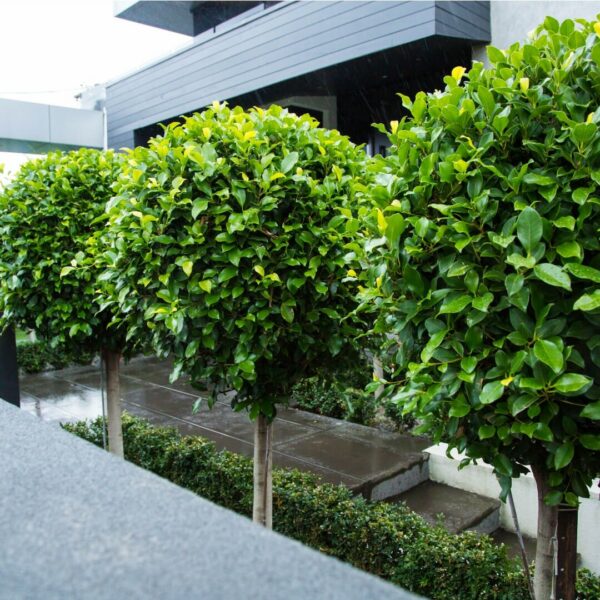
| Description | Ficus microcarpa hillii
Ficus hillii or 'Hill's Weeping Fig' are the hardiest of the evergreen ficus plants and are the number one choice for standardizing. The soft, white bark contrasts beautifully against the exuberant, glossy green foliage, making a feature out of your pleached hedge or standard topiary.
Unlike other ficus, the foliage of the Hill's Weeping Ficus can be hit by a hard frost without recoiling and turning black. Ficus hillii can tolerate a wide range of soils from clay to sandy, preferring a rich, moist loam in which it would thrive. They grow best in full sun to part shade and produce no flowers, making it a no mess hedging option!
Ficus roots are known to be quite vigorous, but can be controlled by keeping the foliage and head of the plant trimmed, roughly 2-4 times a year. They are best planted away from water pipes, easements and pools to avoid any root issues.
For more information on Ficus see our Ficus Factsheet
230 Litre Pot | Wisteria floribunda (syn. W. longissima)
Wisteria 'Longissima' or Japanese Blue Wisteria is arguably the most impressive variety due to it's stunning, extra long pale purple flowers, which can reach lengths of 1m! These sweetly scented flowers are produced in late spring to early summer along with the leaves, and are quite spectacular. Also happy to grow in pots, they are quite hardy but will require solid support.
See our Wisteria Factsheet here for more about the different Wisteria varieties!
For care instructions, features and more, check out Additional Information below | |
| Additional information |
| Botanical Name |
Ficus microcarpa hillii
|
| Other Common Names |
Chinese Banyan, Indian Laurel, Malayan Banyan, White Trunk Ficus
|
| Origin |
Asia, Australia
|
| Leaf Drop |
Evergreen
|
| Plant Type |
Tree
|
| Soil Type |
Clay, Loam, Loamy – Clay, Sandy, Sandy – Loam, Well drained
|
| pH |
Acidic, Neutral
|
| Water Requirement |
Moderate
|
| Tolerances |
Pollution Tolerant, Poor Soil Tolerant, Frost Tolerant, Salt Tolerant, Heat Tolerant, Drought Tolerant
|
| Sunshine |
Afternoon Sun, Full Sun, Part Shade
|
| Planting Distance |
1 every 80cm, 1 per metre
|
| Best time to plant |
All Year
|
| Flowering |
No
|
| Growth Speed |
Fast
|
| Prune Me |
3-5 times a year, Only in the warmer months
|
| Max Height |
10m
|
| Max Width |
3m
|
| Size Maintained at |
2m, 3m
|
| Fertilise Me |
December, February, January, March, November, October, September
|
| Fertilizer Frequency |
Monthly, When needed
|
| Foliage Colour |
Green
|
| Autumn Colour |
|
| Fruit / Seed |
No
|
| Uses |
Hedging & Screening, Pots, Standard, Topiary
|
| Attracts |
|
|
| Botanical Name |
Wisteria flroibunda (syn. Wisteria longissima)
|
| Other Common Names |
Blue Wisteria, Japanese Blue Wisteria, Japanese Purple Wisteria, Japanese Wisteria, Purple Wisteria
|
| Origin |
Japan
|
| Plant Type |
Vine
|
| Leaf Drop |
Deciduous
|
| Sunshine |
Full Sun, Part Shade
|
| Tolerances |
Pollution Tolerant, Poor Soil Tolerant, Frost Tolerant, Heat Tolerant, Drought Tolerant
|
| Soil Type |
Clay, Loam, Loamy – Clay, Sandy, Sandy – Loam, Well drained
|
| pH |
Acidic, Alkaline, Neutral
|
| Water Requirement |
Low
|
| Fertilise Me |
December, November, October, September
|
| Fertilizer Frequency |
Monthly, Until established
|
| Best time to plant |
All Year
|
| Planting Distance |
2m apart
|
| Max Height |
3m, 9m
|
| Max Width |
3m, 6m
|
| Growth Speed |
Fast
|
| Prune Me |
Annually, Hard prune in winter
|
| Size Maintained at |
1m
|
| Flowering |
Yes
|
| Flowering Time |
December, November, October
|
| Flower Colour |
Blue, Purple
|
| Fragrance |
Moderate
|
| Foliage Colour |
Green
|
| Autumn Colour |
Yellow
|
| Fruit / Seed |
Yes – Non-edible
|
| Fruiting Time |
February, January, March
|
| Attracts |
Bees, Birds, Butterflies, Other Insects
|
| Toxic To |
Cats, Children, Dogs
|
| Uses |
Arbour, Archway, Balcony, Feature, Fragrance, Pergola, Verandah
|
| |