| Description | Pyrus calleryana
A narrow, upright form and an excellent choice for space-restricted or compact areas. Glossy green leaves in Summer, Plentiful white flowers pop up in spring and autumn colour of Reds, Oranges and Purples.
Great for fence lines, tree lined driveway, street planting or parks.
Can average 8-10m tall. Can be trimmed to keep at 6m if required.
Grows in a column shape.
10"/25cm pot size | Luma apiculata
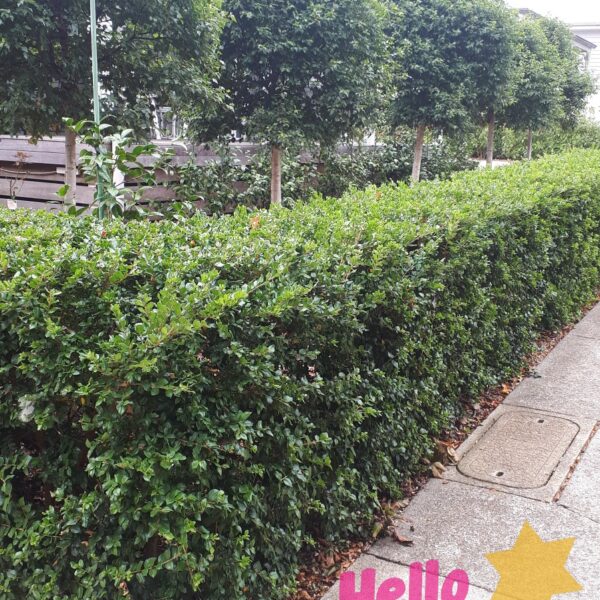
Myrtus Luma is the medium to tall hedge with real traditional style. A lot of people believe the only fast growing larger hedge with fine foliage is the Pittosporum. It is an extraordinarily versatile plant suitable for hedging, screening, topiary, or as a specimen tree, but its small, aromatic leaves respond so well to pruning that it is commonly used as a hedge.
Myrtus luma also makes a wonderful specimen tree if left unpruned. With age it forms an outstanding trunk with cinnamon brown branches. Its bark peels to reveal streaks of pink and beige. What a plant! It really should be seen more in Australian gardens.
| Centella asiatica
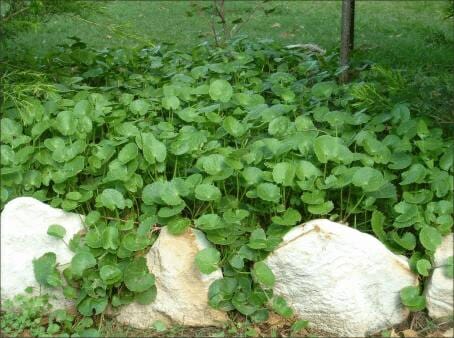
When we think about herbs we think of things like parsley, sage and thyme, which all originate from Southern Europe. We don't hear much about those from Asia, let alone native Australian herbs. "Gotu kola" is more commonly known here as the arthritis plant. This herb has been cultivated in India, China, tropical Asia and Africa for centuries. It comes from the same family of plants as parsley and it has close relatives in Australia. Some of the traditional claims made about the medicinal properties of this plant include ; the extension of life, control of tuberculosis and leprosy, relief of high blood pressure and the pain and swelling associated with arthritis as well as a treatment for cancer and irritating skin ailments. It has also been referred to as Indian Ginseng because of its stimulating effects on many parts of the body. The arthritis herb has been used as a medicine for thousands of years in countries where it grew naturally. It is claimed to have beneficial effect on a number of other ailments including psoriasis, ulcers, rheumatism, acute infections and inflammation, upper respiratory tract infections, diarrhoea, fevers and diseases of the female reproductive organs. Modern clinical tests on humans and animals have confirmed a positive effect in the treatment of skin ailments such as ulcers, burns and wounds. The recommended daily dose is two leaves of 40mm diameter per adult, or the equivalent in smaller leaves. The leaves have a bitter taste particularly if grown in full sun. You may be able to eat the leaves straight from the plant or alternatively they can be chopped up and used like a parsley garnish on salads or mashed potato. It is commonly used to flavour rice dishes in Southeast Asia. A weak tea can be made which you might like to sweeten with honey. The naturally occurring organic chemicals in the leaves include strong alkaloids and a carcinogen called asiaticoside. It is recommended therefore, that you do not exceed this dose as symptoms of headache, dizziness and insomnia have been reported. This plant also goes by the common name of swamp pennywort and this is a clue to its preferred environment, which is shady and swampy. In such a location this plant can grow very quickly. The arthritis plant can be easily grown in the home garden. It thrives under shade in pots, hanging baskets and particularly in bog gardens or by a pond. A good idea is to keep this plant in a confined position such as a tub to prevent it from escaping. And a good potting mix will see this plant take off quickly.
4" pot size. | Argyranthemum frutescens
The pink Marguerite Daisy produces mounds of double pink blooms that grow best in full sun. These shrubs are extremely hardy and will flower throughout spring and summer until the first frosts of autumn, giving you almost constant colour in your garden. They are suitable for pots, borders and cottage gardens. For best results dead head after flowering.
6" pot size
Subject to availability | Acer palmatum dissectum 'Emerald Lace'
Emerald Lace is one of the fastest growing maple. Shaping and pruning when young helps this variety live up to its potential as a wonderful garden specimen. Its Spring growth is lime green with orange margins.
Emerald Lace is very heat tolerant it even tolerates full sun better than most green variety. Fall colour is red.
10"/25cm pot
Available online ONLY – Not in store. | Pittosporum tenuifolium
Wonder Screen is a new form of Pittosporum that is noted for its dense and tighter habit. Similar to 'Silver Sheen' foliage it produces a striking mix of silver and green with dark stems. Although this variety is tolerant of most soil types it prefers a well drained soil in a full sun to semi shade position. Grows to approximately 2-4m in height. |
| Content | Ornamental pear trees are fast growing, tolerant of most soil types, including heavy and poor soils, and best of all they come in a range of shapes and sizes to suit your landscaping requirements.
Check out our Ornamental Pear Tree Factsheet for more info. | | | | | |
| Additional information |
| |
| botanical name |
Centella asiatica, or Hydrocotle asiatica.
|
|
| Botanical Name |
Argyranthemum marguerite
|
| Mature Height |
60cm
|
| Mature Width |
60cm
|
| Uses |
Borders, Pots, Garden Fillers, Cottage
|
| Flowering |
Yes. Spring through to Autumn
|
| Fragrance |
No
|
| Tolerances |
Heat Tolerant, Drought Tolerant
|
| |
| Sunshine |
Full Sun, Part Shade
|
| Fertilise Me |
November, October, September
|
| Fertilizer Frequency |
Annually
|
| Flowering |
No
|
| Fragrance |
None
|
| Fruit / Seed |
No
|
| Growth Speed |
Fast
|
| Leaf Drop |
Evergreen
|
| Origin |
New Zealand
|
| Other Common Names |
Kohuhu, Tawhiwhi
|
| pH |
Acidic, Alkaline, Neutral
|
| Plant Type |
Shrub
|
| Soil Type |
Loam, Loamy – Clay, Sandy – Loam, Well drained
|
| Tolerances |
Pollution Tolerant, Poor Soil Tolerant, Frost Tolerant, Salt Tolerant, Heat Tolerant, Drought Tolerant
|
| Water Requirement |
Low
|
| Max Height |
4m
|
| Max Width |
2m
|
| Toxic To |
Non-toxic
|
| Prune Me |
3-5 times a year
|
| Planting Distance |
1 per metre
|
| Size Maintained at |
2m
|
| Uses |
Hedging & Screening
|
| Foliage Colour |
Grey-Green
|
| Botanical Name |
Pittosporum tenuifolium 'Wonder Screen'
|
|